Don’t overthink it.

There are places that don’t announce themselves as important.
They don’t have a press kit. They don’t have a manifesto.
They just feed you — again and again — until they quietly become part of your nervous system.
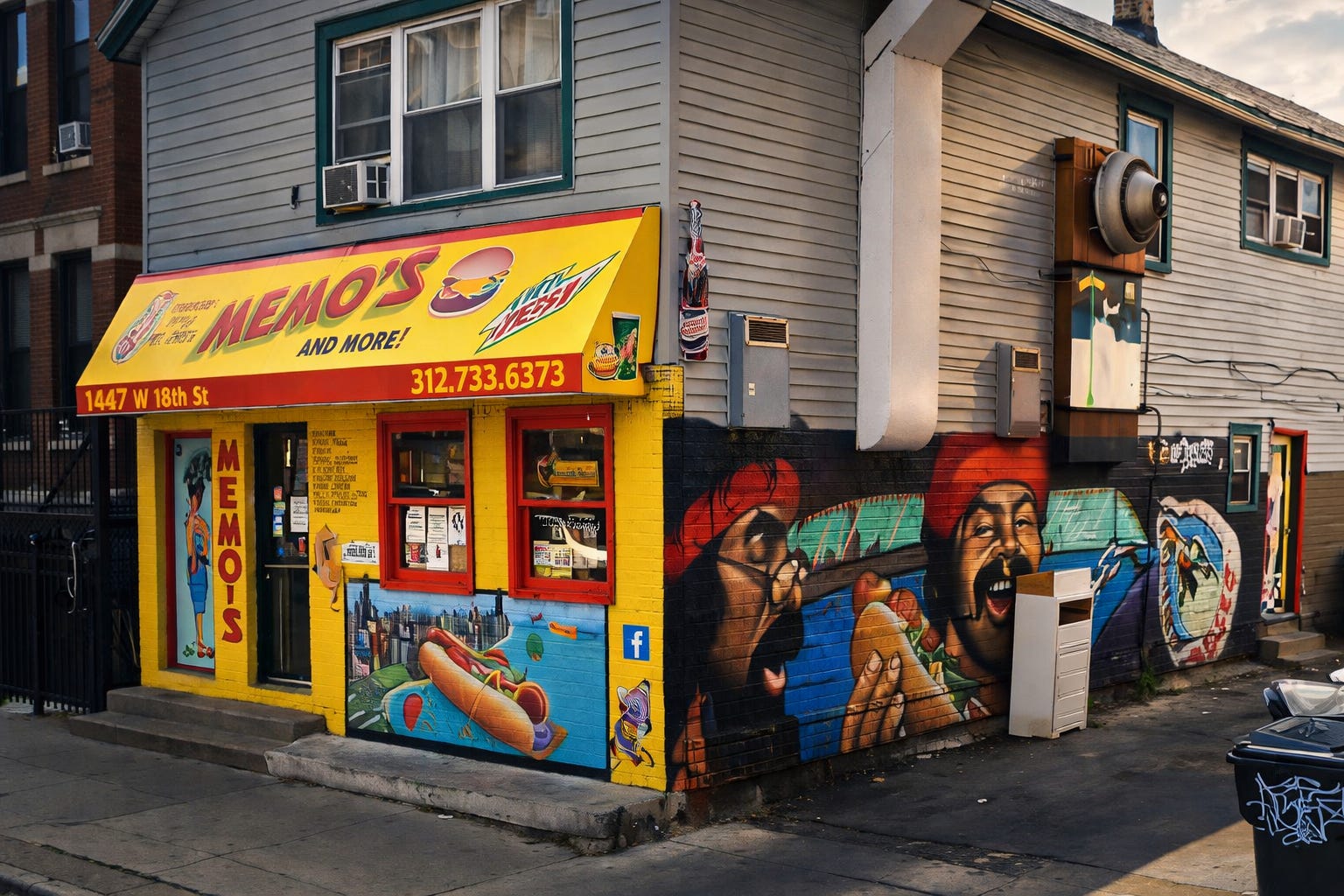
In Pilsen, that place was Memo’s Hot Dogs.
And before that, if you grew up close enough to smell the grill grease on your walk home, you probably knew it as Rodney’s.
This wasn’t a “burger concept.”
It was survival food. Lunch money food. After-school food. The kind of place where you didn’t order — you confirmed.
The cheeseburgers hit the grill flat and honest. No secrets. No theatrics. Beef sizzling into its own fat, cheese melting just fast enough to glue the whole thing together. The fries weren’t an afterthought — they were accomplices. Crinkle-cut or straight, dumped straight into the same paper wrap as the burger so everything shared heat, steam, and destiny.
That paper bundle mattered.
Burger juices soaking into fries. Fries picking up beef and salt and whatever else the universe decided to give you that day. If you wanted ketchup, you didn’t get packets. You asked — and they drizzled it right on the fries, closed the paper, and handed you a small, warm miracle. No lid. No separation. No apologies.
And you washed it all down with an RC Cola.
Not because it was trendy.
Because that’s what they had.
And because that’s what tasted right.
Memo’s — officially — came into its own in the early 1990s, around 1993, under the Garza family. Same corner. Same rhythm. Same working-class logic that says: feed people well, don’t overthink it. Over time the name changed, the sign changed, the neighborhood shifted. But the place didn’t really move. Rodney’s didn’t disappear — it just kept cooking under a different name.
That’s how neighborhood joints survive. Ownership changes. Paint peels. Stories blur. But the grill stays hot.
By the time people started calling it a “Pilsen staple,” it had already done decades of quiet work. Kids who ate there after school came back as adults, then came back again with kids of their own. A double cheeseburger and fries in a paper bag became a family tradition you didn’t even realize you were passing down.
Even the city tried to get in its way once. In 2022, a mural on the building — art, not advertising — triggered a bureaucratic shutdown over permits and definitions. The kind of moment where a place like this could’ve disappeared for good. But the neighborhood spoke up. Loudly. And the city backed off. Because some places aren’t just businesses — they’re infrastructure.
Memo’s exists in that space where Pilsen lives: working-class, Mexican-American, creative, stubborn, proud. Surrounded by murals, taquerias, galleries, and stories written in three languages and grease stains. It doesn’t compete with the neighborhood — it belongs to it.
You don’t go to Memo’s for nostalgia.
You go because it still does the thing the right way.
Paper wrap.
Burger and fries sharing heat.
Ketchup already on the fries.
RC in your hand.
Classic.